What does a Composer (Concert and Stage) do?
While some composers construct works intuitively or by ear, the broad majority possess advanced training in complex music notation, historical works, and contemporary performance practices. Composers may write for voices as well as for instruments, and might incorporate or rely entirely on electronic and digital music tools. While a new work may be purely a product of a composer’s urge to create, most professional composers also create new projects that they propose to institutions for production. In addition, a professional composer might work on commission, at the behest of a performance group, arts organization, or individual.

At a Glance
Some say that concert and stage composition is more art than career; the truth is that it is both, and there is far more than a single way to approach this field. Most concert composers begin by completing an undergraduate music program, after which they might set out into the world to work professionally, seek a mentorship or residency with a prominent composer or orchestra (many of which are located in Europe), or continue into higher education to obtain a master's degree, PhD, or DMA. Whatever path they take, almost all concert composers will eventually need a day job to pay the bills—and, one hopes, to further develop their art and career.
In order to gain notice and get their work performed, composers might enter their work in national and international contests, seek out composer-in-residence opportunities, become the bandleader for a new or existing ensemble, or even produce their own events. Composers also frequently utilize connections developed during their education and mentorship to get their music seen by music directors and performed by successful orchestras. All said, the path to getting work performed and developing a reputation is paved with numerous collaborations and connections with other composers, musicians, conductors, and live performance professionals.
- Music composition
- Reading and writing music
- Music theory
- Instrumental performance
- Arranging/orchestrating
- Conducting
- Event and ensemble production
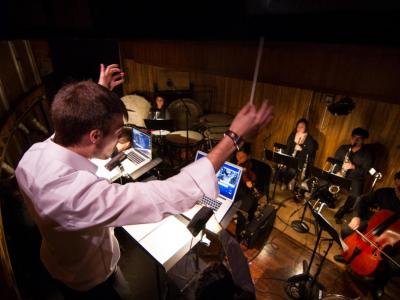
Although composition is often a solitary creative practice, bringing music to life requires extensive collaboration with conductors, performers, producers, and artistic leaders. Successful composers communicate musical ideas clearly, adapt to practical performance considerations, and incorporate constructive feedback while maintaining their artistic vision. Strong communication, professionalism, flexibility, and collaborative problem-solving skills are valuable assets throughout the compositional and rehearsal process.
The day-to-day life of a concert composer is highly independent and split between intense periods of isolated desk work and active social collaboration. When working on a tight commission deadline, composers spend long, meticulous hours alone inside home or commercial workspaces. However, when the piece transitions to production, the composer’s life shifts completely to the public sphere, attending active rehearsals, working with musical directors, traveling to international festivals, and networking with audience members, patrons, and fellow musicians in concert halls and creative workshops.